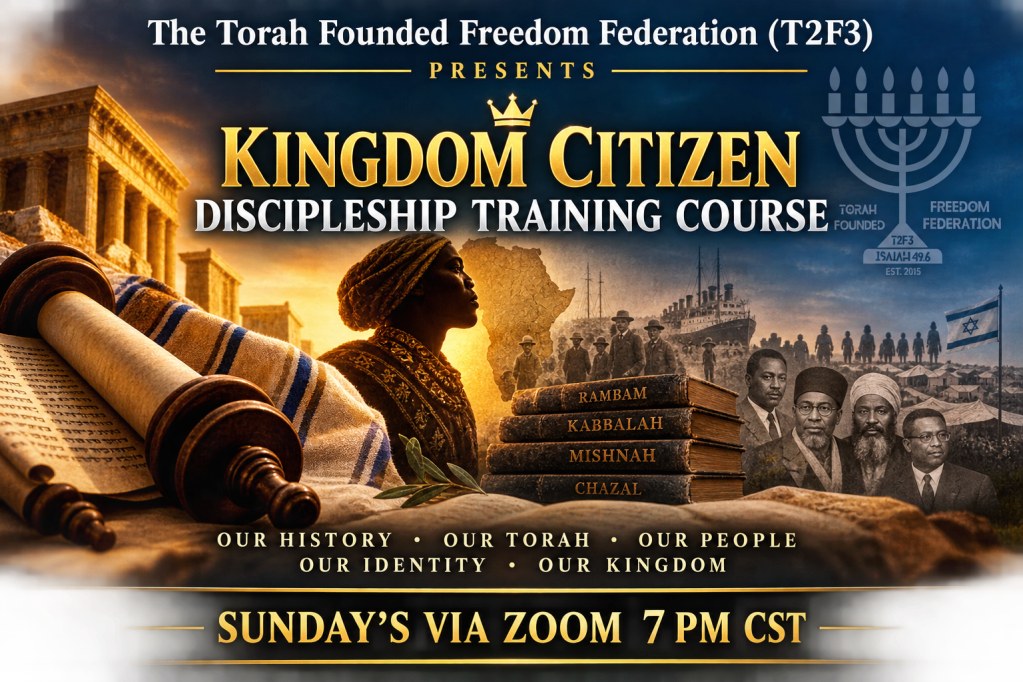
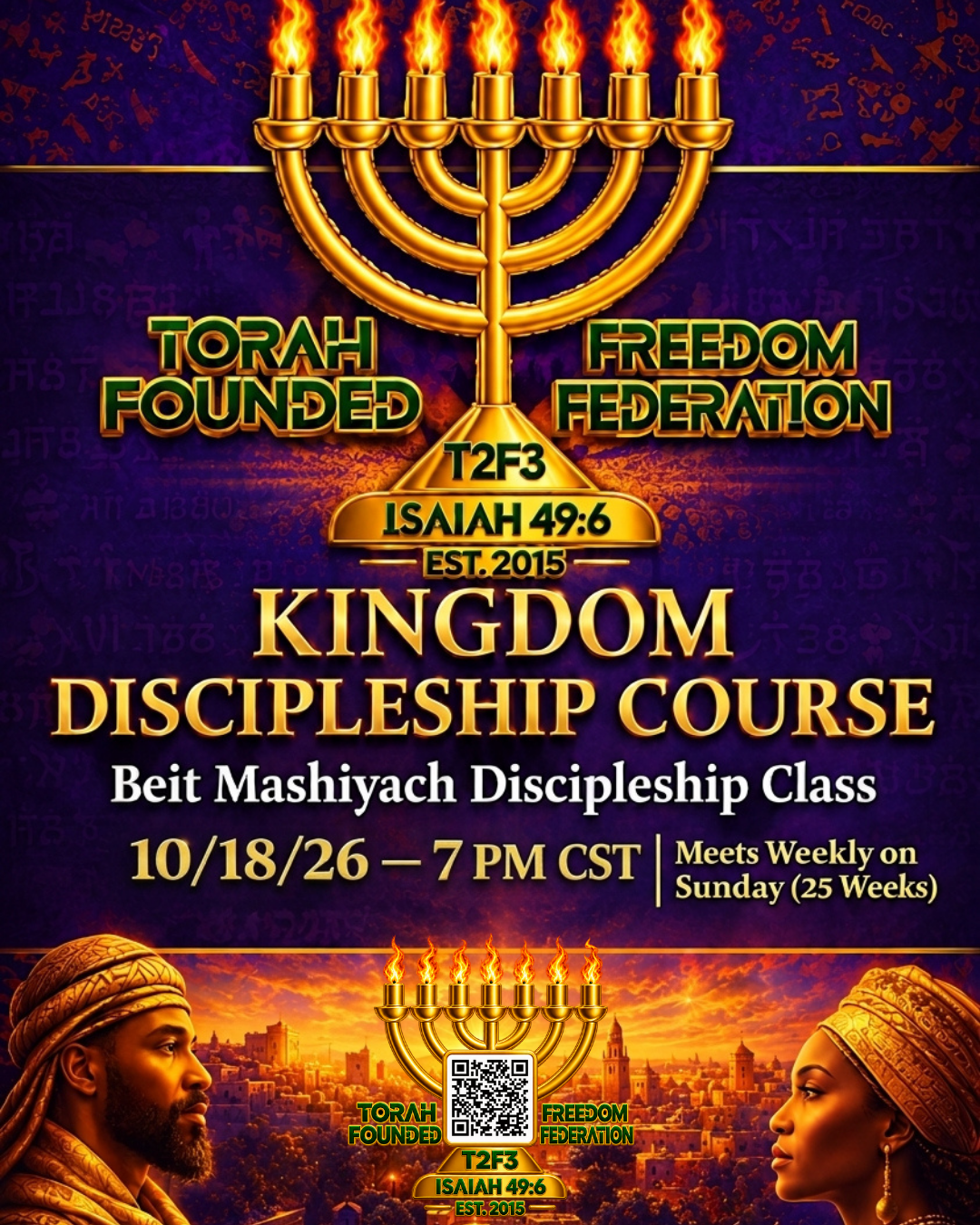
[Scan QR Code to register for course]
Our community carries a rich legacy of Torah living shaped through an Afrikan paradigm, yet many of our people grow up without a clear map connecting that legacy to its full cultural and historical roots. The Beit Mashiyach Discipleship Course exists to build that map, giving every student a foundational and comprehensive Israelite consciousness grounded in culture, faith and history.
This annual course opens with Rambam’s 13 Principles of Faith, establishing the philosophical and idelological bedrock that has anchored Israelite belief across centuries. From there, students journey through the Afrikan expression of Torah culture during Temple times, the oral tradition texts that carried the law forward, the teachings of Kabbalah, and the generations of Chazal Rabbis who preserved our sacred texts through the Mishnaic ages. The course traces the tribes of Israel through the Afrikan Diaspora, documents our history through slave ship manifests, and honors the prophets and founders who rekindled our identity, Prophet F.S. Cherry, William Saunders Crowdy, Wentworth Arthur Matthew, and Arnold Josiah Ford among them. Students then follow the story into contemporary movements, from the Kingdom of Israel in Dimona to the growth of 1 West doctrine and its camps.
Twenty-five weeks give our community the space to hold all of this together as one continuous story, our principles, our communities, our ages, our texts, woven into a single body of consciousness. Each student who completes the course steps forward not simply with knowledge, but with identity, prepared to carry the legacy of the Kingdom into active service.
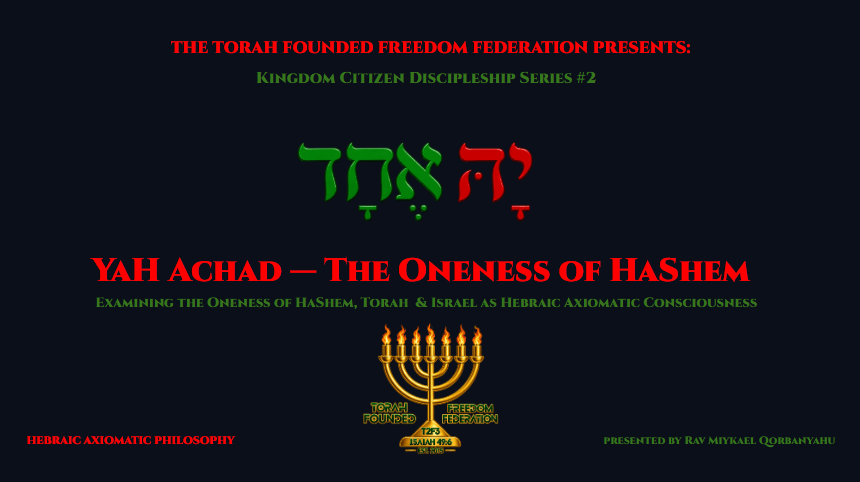
This week, we dive deep into the foundational truth of Hebraic consciousness: YaH Achad (YaH is One). Together, we will examine the absolute Oneness of the Creator, exploring how Deuteronomy 6:4 (The Shema), the wisdom of Duties of the Heart, the teachings of Maran Rebbe Yahoshua ben Yoseph in John 17, and our ancient oral tradition reveal the unbreakable covenant bond between HaShem, Torah, and Israel.
Beit Mashiyach invites every member of our community to join this annual course. Bring your questions, your curiosity, and your commitment, and walk this journey together as we build a generation of messianic citizens rooted deeply in faith and history alike.
Looking for leaders to facilitate one or more of the 90 minute class taking place annually every Sunday for 26 weeks beginning with the first Yom Rishon (first day/Sunday) at 7 pm cst via Zoom.
Choose a topic that resonates with you and be ready to facilitate the course with a brief presentation/conversation to edify our body of Torah observant Hebrews.
If you’re interested in facilitating a course(s), reply to this message with the course(s) at beitmashiyachkc@gmail.com. We also take love offerings via Venmo @RaMiQo.
Shalom u’geveruah!!!
The topics are as follows:
PART ONE: THE 13 PRINCIPLES OF FAITH
Week 1 – Existence of the Creator (Rav Qorbanyahu)
Foundations of Beit Mashiyach’s mission and covenant identity. Establish study methods and vocabulary for the course.
Week 2 – Unity of the Creator (Rav Qorbanyahu)
God’s oneness as the root of Israelite monotheism and covenant identity.
Week 3 – Incorporeality of the Creator (Rabbinet Hadassah)
God’s nature beyond physical form, and why this principle shapes proper worship.
Week 4 – Eternity of the Creatorm (Moreh Kathar)
God as first and last, without beginning or end, and what this means for covenant permanence.
Week 5 – Worship of HaShem Alone
The exclusivity of worship due to the Creator, and its role in Israelite identity across history.
Week 6 – Prophecy (Rav Qorbanyahu)
The nature of true prophecy as a channel of divine communication to Israel.
Week 7 – Prayer & Meditation (Rabbinet Malkah)
Understanding the literary structure and heart led prayers of Israel, understanding how the Psalms and traditional liturgy carry both form and feeling as vehicles of covenant intimacy. Week 7 then opens the door into hitbodedut, the practice of silent, personal communion where the student learns to sit in stillness and listen as much as speak.
Week 8 – Moshe as Chief of the Prophets (Moreh Kathar YaH)
Moses’ unique authority and the unmatched nature of his prophecy.
Week 9 – Torah Given at Sinai (Nasik Rav Mishpat)
The Sinai covenant as the foundation of Israelite law and identity.
Week 10 – Immutability of the Torah
The Torah’s unchanging nature across generations and circumstances.
Week 11 – HaShem’s Knowledge of Man’s Deeds
Divine omniscience and its bearing on human accountability.
Week 12 – Reward and Punishment (Rabbinet Hadassah)
Divine justice as the framework for righteous living.
Week 13 – Coming of the Messiah (Nasik Rav Mishpat)
The messianic hope as a living expectation within Israelite faith.
Week 14 – Resurrection of the Dead
The culmination of faith in bodily resurrection, closing the covenantal foundation of the course.
PART TWO: THE HISTORICAL AND TEXTUAL MATTER
Week 15 – Afrikan Expression of Torah Culture in Temple Times (Moreh Kimathi)
Kushite and Ethiopian connections to Israelite worship, the Elephantine community in Egypt, and biblical references linking Africa to the Temple-era nation.
Week 16 – Post-Temple Continuity in the Afrikan Diaspora
Beta Israel of Ethiopia and West Afrikan communities carrying Hebraic practice forward through the centuries leading to the slave trade era.
Week 17 – Oral Tradition Texts (Rabbinet Hadassah)
The Mishnah, Talmud, and Midrash as the living companion to the written Torah, and their role in preserving law across dispersion.
Week 18 – Israel’s List of Chazal Rabbis
The sages from the Zugot through the Tannaim and Amoraim, including Hillel, Shammai, Rabbi Akiva, and Rabbi Yehuda HaNasi.
Week 19 – Mishnaic Ages
The Six Orders of the Mishnah and the historical periods that produced them, connecting Second Temple life to post-Temple survival.
Week 20 – Kabbalah Texts, Ideas, Principles, and Teachers (Rabbinet Haddasah)
Sefer Yetzirah, the Zohar, Rabbi Shimon bar Yochai, the Sefirot, Tzimtzum, Tikkun, and Rabbi Isaac Luria’s Safed circle.
Week 21 – Tribes of Israel in the Afrikan Diaspora
Tribal identifications and retained practices carried through Afrikan communities into the broader Diaspora.
Week 22 – Afrikan-American Jewish History: Manifests to Movement (Moreh Kimathi)
Documentation of Israelite origins through slave ship manifests, tribal markings, and retained Hebraic practices among enslaved Afrikans, opening directly into the founders who rekindled that identity: Prophet F.S. Cherry and the Church of the Living God, William Saunders Crowdy and the Church of God and Saints of Christ, and additional figures such as Wentworth Arthur Matthew and Arnold Josiah Ford.
Week 23 – Contemporary Movements: Dimona and Its Outgrowths (Moreh Elihu)
Ben Ammi Ben-Israel and the Afrikan Hebrew Israelites of Jerusalem, their exodus through Liberia, and the movements that grew from this root.
Week 24 – Development and Growth of 1 West Doctrine and Camps (Moreh Kimathi)
The founding of 1 West doctrine, its leadership lineage, and the expansion into distinct camps with varying teaching emphases.
Week 25 – The Kingdom: Synthesis and Commissioning (Rav Qorbanyahu)
Students weave the 13 Principles together with the full historical arc, from Temple-era Africa to the slave ships to Dimona to the present congregation, framed through citizenship in the Kingdom. This final session commissions each student as a new messianic citizen of the Kingdom, carrying the teaching and legacy forward into active service.